Labels

Showing posts with label TESTING. Show all posts

Jan 30, 2014

Matthew and I discussed the filters and where to put the plant. At first, we were thinking of putting it on the top of the structure, but then we would have to drill holes in the ceiling and hang the light like that or put the light across the structure. The light would keep the plant alive, but would block the bucket and we wouldn’t be able to pour water into our system. We decided  to put the plant into the 55 Gallon drum and put the light across there. We don’t need to pour the water into the 55 Gallon drum, so that will work very well. Matthew will run it by our professors to make sure that can be doable. He also suggested to let our contaminated water sit for a few days so the nitrates can form. Right now, there is only ammonia in the water. The nitrates, if there are any, would be in the 55 Gallon drum in the Biofilm layer.


                                                                                                               Alex


Jan 1, 2014

 I went to dump water into the filters. Mom got the 3rd filter up and running, but the first tantalus is leaking. It needs the glue stuff. We will fill the bottom for now. I got 2 Gallons of water from the house. I had to carry one at a time as the small bucket didn't have a handle. The ice was treacherous. I made sure to put manure in the water.

                                                        Alex

Research Tasks for This Week

Just posting, for reference, the research tasks each team member has agreed to take on for this week. A question mark denotes the member has not yet responded.

Vienna: "What is the water in the Philippines contaminated with/What kind of parasites/How do parasites get into the water?"

Alex: "Why is the Philippines' water contaminated/geography of the Philippines."

Stella: ?

Harrison: All nitrate-related questions

Matthew: Flow rate research, slow sand filters vs. rapid sand filters. What is optimal flow rate for our cascading filter, as compared to standard filters.

Andrew: Continued testing for Cascading filter.

I'm also currently working on assembling more Tantaluses for both the water and whey filter systems. I'll fill everyone in with the details during my weakly update.

Matthew

10/03/13 Meeting Notes

Had a great discussion with a representative from the Department of Health. During our two-hour meeting we discussed our filter, the design, and how it compares to traditional methods of slow sand filtration. We discussed the overall effectiveness of bio-sand filters removing contaminants from water, alternate filtration systems, and contaminants in the water found in the Philippines.

We determined several things from the meeting, the most notable being that we need to determine the filter's flow rate. The flow rate must be correct for proper filtration. The optimal flow rates are unknown currently, but are dependent on the medium used.

We also discussed the problem of nitrates in drinking water in the Philippines. Nitrates come from sewage, and are a major problem as they cannot be filtered out with either our bio-sand filter or our Cascading pre-filter system. Nitrates can be treated through certain ultraviolet light systems, but such systems are expensive and not easy to replicate with our materials.

We discussed other ways to treat for nitrates, and learned that plants can drink the nitrogen compound in the water. We reasoned that we could utilize a locally available, economically useful plant in the Philippines (if we could find one) and implement it into our Cascading filter as an additional stage of pre-treatment. While this is currently still theoretical, it definitely merits further discussion.

Also discussed were testing our water, where the team can find a contaminated source of water, and if we can purposefully contaminate water with bacteria such as E. coli in order to test our filter system's effectiveness on truly contaminated water.

That's all for now. We are possibly meeting this weekend to build a couple more whey pre-filters, but this is dependent on several team member's schedules.

-Matt

Department of Health Recommended Links

Just a small list of articles the Department of Health has listed as recommended reading, provided here for reference.

Current Filter Schedule

For reference, here is September's schedule for filling the filter.

----

Sunday: Andrew

Monday: Stella

Tuesday: Matthew

Wednesday: Alex

Thursday: Matthew

Friday: Stella

Saturday: Andrew

----

While unlikely, note this is subject to change based on the schedules of team members. I will update this list if anything changes.

~Matthew


Saturday (Oct 20, 2012) meeting

Hello all,

This is a rather late report on what happened on Saturday. We worked on cleaning and re-setting up the hybrid pre-filter. We found that the big red sand filter has a problem, the water doesn't flow well through it. We currently think it's just air caught in the middle, and that it will sort itself out. We also worked on the pump design.
The next meeting will  be on Wednesday, October 24th, at 6:00 PM going until 8:00 PM. This is to check on the filter and hybrid pre-filter, and to discuss some funding issues. We will also discuss making the pump, and if there are parts, start building it. The reason we have to discuss funding is that the MIT grant extension program got canned for this year, so no one from the 2011-2012 Inventeams will be getting a grant. (If I'm wrong on this, please correct me Matt)

Harrison

Turbidity Meter May 17 2012

We called the LaMotte company about the turbidity meter. On Tuesday Endyne brought their calibration sample and we learned that our meter does not calibration properly. Our turbidity meter has been giving us three higher then we are supposed to have. Chris Lafountain went though with us how they do their water testing to see if it would help. they sent us a loaner meter and will repair ours. The loaner meter should arrive on Saturday.

Testing Results May 17 2012


May 15, 2012 Learning How To Test Water

Today we  learned how to test water and how to clean the viles without scratching them up. We also learned how Endyne tests their water. We also learned how to prepare the viles for testing.


We have new procedures for testing using the LaMotte 2020 wi turbidimeter calibration system:

1. Calibrate the system according to the manual.
2. Take the glass vial and pour distilled water into the vial. Shake to remove foreign materials, and dump the water out. Repeat the process two more times.
3. Collect a water sample from your filters and cap your sample. Invert the sample jar three times to ensure the water particles are spread throughout the sample.
4. Pour the sample into the glass test vial. Cap the test vial. Shake the sample and dump the sample out. Complete this step one more time.
5. Invert your test sample three times. Immediately pour into your test vial. Invert your test vial five times. Wipe down the vial with a lint-free cloth.
6. Place the vial in the turbidity meter.
7. Use meter to test the sample from the filters.


Those who learned how to water test were the following: Caleb, Alex, Liam, Grace, Vienna, Bradley
Those who attended the meeting were: Harrison, Caleb, Alex, Liam, Grace, Vienna, Bradley, Matthew, Joshua, Michael, Emma.

Monday 16 April 2012 Testing Results


We received the first set of testing back from Endyne. It takes more than a week for them to mail us the results. We learned that the water from the Little Ausable River had e-col, but the water from our filters was e coli free! The filtered water did still show the presence of coliform. The test results were disappointing as very little information was provided. We do not know the level of coliform so we can not see if the filters reduced any. The exciting bit was learning we did eliminate e coli. Various people have told us that the sand filters would NOT eliminate e coli.


Pre-filterwork

We broke into two teams to build flood and drain filters. One team worked on the second tantalus pre-filter while the other team completed a much more simple design that involved a simple flexible hose. (Picture to be posted later.) The simple filter is complete and ready to be hung from the structure. The tantalus needs some modification.

First Water Samples Sent to Endyne

We sent our first samples of water to Endyne (state water testing lab) to get a base-line for the project. We sent a sample of water from the Little Ausable River along with a sample from the Red Sand Filter (the one using natural sand).

We are testing for:  total coliform, aluminum

The results will be sent to the 4H Office in Westport.

Test to be preformed on the water

Today I talked to Scott Benware about the different test we need to preform for the filter. He says we should test for Coliform, Ecoli, Aluminum, Sodium, and PH. Tomorrow I am going to  contact Endyne  and get the bottles for the testing.

caleb.

Pre-Filter Updates

A small group meet on Wed from 1-3 to work on the prefilters. We wanted to see if we could get the Tantalus operating on a biosand filter. We decided to remove the sand and check on the cap at the bottom of the filter. As we went to lift the bag of sand out we discovered that the bottom of the bag had disintegrated.

Bag Bottom Completely Open
When we removed the "bag" and the sand stayed behind. We removed the sand and cleaned the top layer of rock to remove all sand from the rock.


Pre-Filter With Sand Removed
We tested the water's ability to flow through the feed bag and found that it flowed through two layers without holes. We tried several ways to put the bag in the container such that it would hold the sand. Each time we added water we noticed ways the water could escape and avoid the sand filtration. When we had just the sand, the water was flowing through the sand too quickly. We finally decided to use another bag. We placed it in the bucket on top of the rock layer and filled to the top of the bucket with sand. We will monitor how long it takes the bag to disintegrate. (This bag was slightly different from the previous feed bag.) We folded the bag top over and placed an empty 5 gallon bucket on top that had 4 holes in it. We discovered the folded over bag top encouraged more spillage.


We finally opted this design: 5 gallon bucket with Tantalus structure from earlier testing (using the cap to build pressure), approx 4 inches of small pebbles, manufactured sand held in a feed bag, and another  5 gallon bucket on top of the sand inside the feed bag. The 5 gallon bucket has 4 holes (the holes were already there--might prefer use 2 holes). The top bucket acts as a storage bucket. It can handle 2 gallons at a time and has a even flow rate. The Tantalus will keep the water in the lower bucket until the water level reaches the top of the filter bucket.


Pre-filter with Tantalus Attached


(This brings to question whether the bags in our main filters are working as an effective barrier layer. If they are not holding up as we thought, it explains the sand getting through.)

Contacted Endyne- local testing facitlity

I called Endyne, a state certified water testing lab in Plattsburgh. They are very willing to talk to us about turbidity and how they do their testing. They will go over our testing procedures with us and make recommendations.

They will explain the different tests they do. 

They charge $15 for a water solids test to know what is in the water
They charge $11 for a turbidity test.

The woman I spoke with wondered if what we are seeing in our turbidity of 1.x (where x is variable) is really just some small particles of sand and not contaminates. She recommended a screen filter at the output. We talked about several options, especially recycled items.

We will need to test a piece of cotton that we boil/sanitize and put it on the inside of the filter at the output location. This will keep any "stray" sand from coming out. If it is inside the filter, it will limit external contaminates. It would need to get changed regularly. We will have to test to determine how regularly is needed. Externally, we would replace every other day at minimum.

For initial testing we can see if this makes a difference by having the water poured through a cloth before we put it in the testing bottle.

(ms/admin)

Sunday March 18 2012

We met at the Peru Fire Department at 4:30 and went till 8:30. After dinner we broke into groups and worked on the project.

Josh worked on drawing a cartoon on how to build a filter and created a technical drawing of the pre-filters.

Michal read about how to use a turbidity meter to make sure we were using the machine properly.

The fabrication team redesigned the pre-filters. We removed the clear pipe tubing and replaced it with a fixed PVC Tantalus. Then we experimented with making a pre-filter with rock and sand with the Tantalus attached. The testing team tested different ways to control the flow of the water. 

(Pictures to be posted later)

Tantalus adjustments


The height of “A” determines how much water the Tantalus will draw. The suction is adjusted by the length of the pipe; a longer pipe equals more suction. The height of “B” determines how high the water head has to be before the Tantalus starts to drain the bucket. Pipe “C” should be long enough to direct the flow into the bucket below. It plays a small role in how much suction is generated. As a note, the height of “A” should be adjusted so that the volume of water that travels through the sand is enough to create a full flow, preventing too much water draw from breaking the cycle and causing a trickle of water.

(Another shot of the pipe Tantalus) 

Also, a short video of the Tantalus:

Turbidity Testing on Tuesday and Wedneday 13-14 March


Tuesday Bradley, Grace, and Liam added water to the filter and tested the turbidity. They decided that 10 tests would be recorded for each sample so the outliers could be discarded and a statistical answer found for the result. They considered graphing the solutions with software. They decided the turbidity settles over time, so they wold slightly swirl the sample and allow it to come to rest before putting in back in the turbidity meter. The turbidity scores were much higher. The water in was testing at about 48 and the water from both filters was in the 3 range.

A chart is hung on the structure to record the readings.  


Wednesday Grace and Liam added water and tested. They noticed the filters were both doing better than the day before. The Black filter ranged from 0.17-0.7

SUNDAY 11 MARCH 2012

A small group meet on Sunday afternoon to work on the Tantalus.

First the group collected water from the Little Ausable River from the Route 22 overpass. They threw a bucket down to the water attached to a 100ft cord and hauled water to fill two 5 gallon buckets. To ensure the bucket would not get pulled away with the current, the end was tied to the railing.  
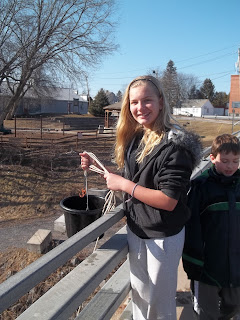
Emma preparing to drop the bucket over
 
The Water Hauling Team

It's a long way down!
Bradley waiting for his turn

After hauling the water back to the fire station and filling the two biosand  filters, they set to work on adding a “Cup” device to the pipe inside the bucket. A hole needed to be drilled in the plastic cup to fit the “fitting” through. One of the leaders discovered the drill bit was in his tool bag BUT not the drill. The fire department did not have one. (They asked.) Liam put the plastic cup in the fire department vice and with a pare of adjustable pliers holding the drill bit, hand drilled the hole. 

 Liam drilling the hole by hand
Since this was a lengthy process to get through the plastic, the other members learned to use the Turbidity meter. First they had to gather samples:

Filling the sample bottle

Putting on the screw cap
Filling the testing jar

With help from the Matt (leader who has used one before) and a quick cursory read of the directions, we started testing the water. We opted to use the number 10 solution for the calibration. We tested the water that was collected from the Little Ausable and it has a turbidity of 24. The guide said we wanted below 0.3 to drink. We tested the water coming out of each filter. The Red filter (natural sand) has a reading of 3.4 and the Black filter (manufactured sand) has a reading of 0.31. We were ecstatic! Our filters were definitely starting to work.
Reading the turbidity meter results


By the time the water testing was done, Liam (with a very sore hand) had the hole drilled. We added it to the inside of the pipe in the bucket to generate more air pressure so regulate the flow in the Tantalus better. It helped build more air pressure but there was a constant drip instead of a shut off.
Plastic dish with fitting attached
A look from the inside
Bradley holding the whole assembly

Then came the 2 hours of watching the Tantalus work and making minor modifications. We moved the coils, cut cable ties (intentionally restricting the flow in places as well as holding loops together), and changed the height of the pipe inside the bucket. After about 40 minutes of watching, Madeline and Bradley noticed that the problem seemed to be in the two-coil loop. They suspected if the coil was just one loop, the Tantalus would operate effectively. We were waiting for one leader to return with dinner before we cut the plastic tubing, so the other leader held the plastic piping in position. (It was too long with only one loop and kept wanting to recoil.) Matt actually had a short piece of plastic tubing that Liam bent into a loop and tied with cable ties. It worked! (Sort of a Eureka moment!) We watched it for about an hour to make sure it would constantly work.

Grace spent most to the time working on the guidelines for making the turbidity meter work. We learned you can only calibrate the system a couple of times and then it won't let you for a while. We learned that the same sample can give different reading so a procedure would need to be developed.


Members Present: Bradley N., Liam S., Grace S., Emma S., Madeline L., plus two leaders and one parent